
Protogen fursuit: what it is, how it’s made, and what to look for when ordering
What a Protogen is, what a Protogen fursuit consists of, how the visor and electronics work, and how to avoid mistakes when choosing a maker and selecting the suit's features.
- #species
- #protogen
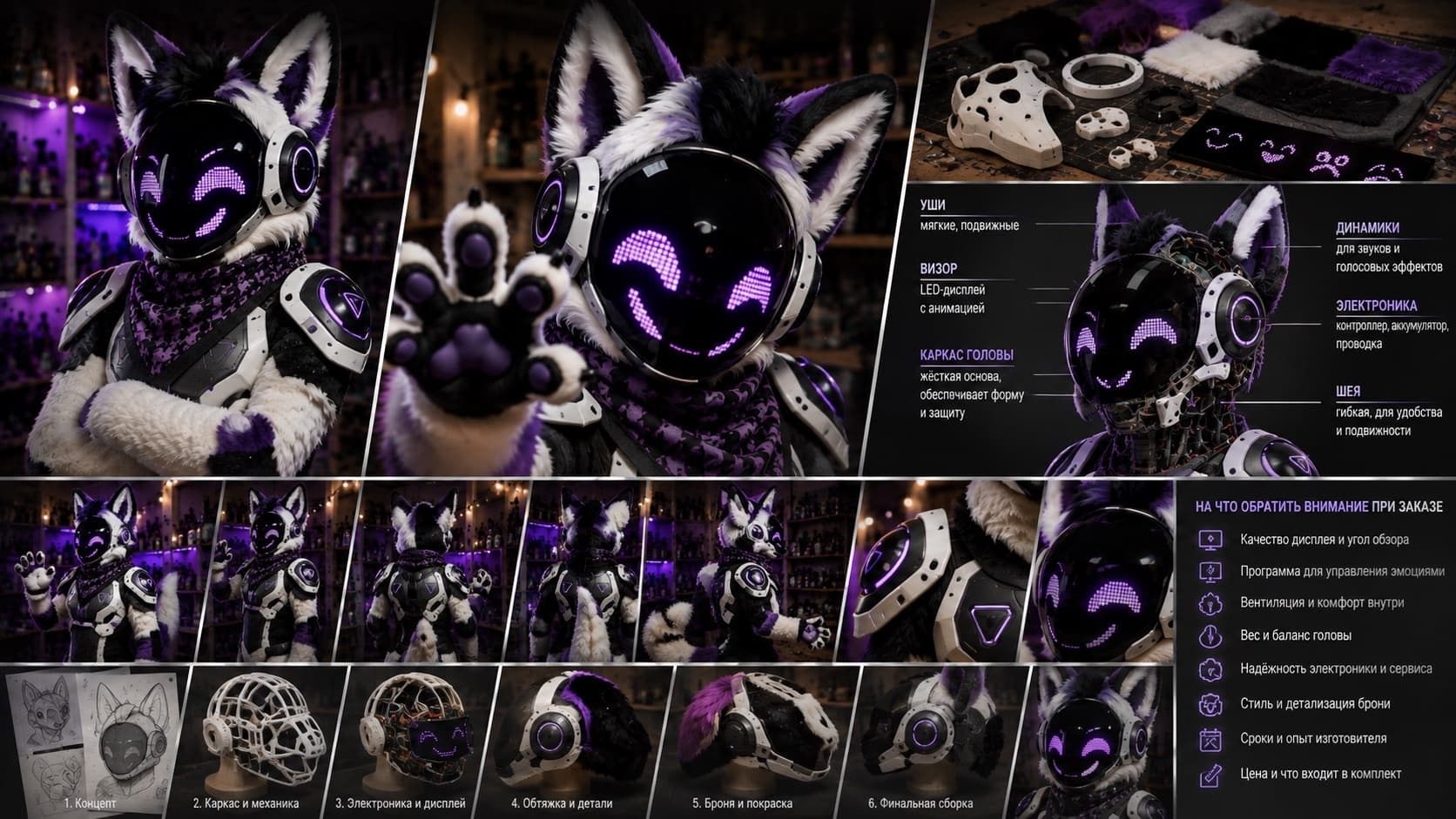
What is a protogen?
The Protogen is a fictional species within the furry community: an anthropomorphic character combining animal and "cyborg" traits. Its most distinctive feature is a visor replacing the conventional muzzle, eyes, and nose; a "face" is displayed on the visor as an animation or graphic.
Protogens have gained popularity thanks to their futuristic appearance and customization options. Search queries—such as "Protogen fursuit," which generates hundreds of hits per month—indicate sustained interest.
What a Protogen fursuit consists of
- Head with visor. A fur-covered base featuring a dark, transparent visor panel.
- Electronics. LEDs or LED matrices that form the "face." Controlled by a microcontroller and powered by a battery.
- Ears and "hairstyle" — often large, sometimes featuring glowing inserts.
- Fur and details — coloring and patterns based on your reference; sometimes includes glowing elements on the body.
- Tail, paws, and body — available in your choice of format: ranging from just the head to a full suit.
How the visor and electronics work
Visor — This is a piece of tinted, semi-transparent plastic, similar to the material used for sunglasses lenses. It is vacuum-formed over a mold and then tinted. The tinting obscures the wearer's face and the internal electronics from the outside while allowing LED light to shine through. Many makers do not fabricate the visor themselves but source it from specialized studios, as the process requires vacuum-forming equipment.
LEDs. The Protogen’s "face" is assembled from LED matrices. Two common approaches exist:
- 8×8 modules using the MAX7219 driver — one for each eye, the nose, and the mouth;
- flexible addressable RGB LED matrices — for example, an 8×32 format (one pixel per square centimeter). The low resolution is considered part of the Protogen's charm.
Control System. Typically, an Arduino-style microcontroller is used. Models with Wi-Fi connectivity allow the user to change expressions via a smartphone, while ready-made Protogen kits often include USB-C power (via a portable battery), dual cooling fans, and sensors—such as a "boop" sensor (for nose touches) or an IR proximity sensor.
Ventilation. Small fans cool the enclosed head; a single fan is often placed under the chin, whereas ready-made kits typically use two.
To ensure everything works effectively, it is important that:
- the user can see out — through dedicated openings or tinted mesh;
- the display is legible from a distance;
- the electronics are protected against moisture and sweat.
Both the visual impact and the wearer's comfort depend on the quality of these design choices. Discuss them with the maker before work begins.
What to look for when choosing
- Visibility and ventilation. Visibility and breathing are the main challenges with a closed visor. Ask the maker how they handle this—using fans, vents, or mesh.
- Power and safety. LiFePO4 batteries are preferable for the head; they are safer than lithium-polymer (LiPo) batteries, which can catch fire if damaged or chosen incorrectly. The battery should not be positioned near the face; it must be securely mounted and insulated from the body. Ask about the charging system, battery life (will it last the whole day?), and how to replace the battery.
- Repairability. Electronics can fail. It is best if the components are removable and the maker is willing to service the product.
- Head weight. Electronics and batteries add weight; ensure the head remains comfortable to wear.
- Image control. Find out how to change expressions and what modes are available—such as presets, button-activated, or sensor-based controls.
- Maker's portfolio. It is best to choose someone who has already created Protogens; electronics expertise is a specialized skill.
How much does it cost?
A Protogen suit is generally more expensive than a "standard" fursuit of the same type due to the addition of a visor, electronics, assembly, and configuration. The exact price depends on:
- the format (head-only, partial, or full suit);
- the complexity of the electronics;
- materials and design.
The general pricing logic is explained in the article "How Much Does a Fursuit Cost?", and our rates can be found in the "Pricing" section.
Order, buy ready-made, or make it yourself
- Order a custom suit. A good choice if you have your own design and need a custom fit. You can find details on the process in the ordering guide.
- Buy a ready-made suit. Faster, but you’ll have to accept someone else’s design and size. Be sure to check that the electronics are working properly.
- Make it yourself. An option if you’re willing to learn about electronics and working with plastic and fur. Ready-made patterns and bases simplify the task but still require time.
Typical issues worth discussing in advance
Based on the experience of hobbyists and makers who build Protogens:
- The frame scratches the ears when putting the mask on or taking it off. Ensure there is enough width clearance and that the edges aren't sharp.
- The magnetic visor mount weakens over time and requires reinforcement.
- Fragility. Drops can damage the jaw and frame; a hard case is needed for storage and transport.
- Electronics reliability. Soldering on a breadboard is less reliable than on a proper circuit board; ask how the circuitry is assembled.
- Fit. Patterns are often created using tape and plastic wrap; without an accurate head and shoulder mold, the fur and frame won't fit correctly.
Care and Operation
- Keep the electronics dry. Avoid rain and excessive sweat; follow the maker's instructions regarding protection.
- Store separately from the fur: ensure batteries and wires do not get crushed.
- Charge in advance and bring a spare power source to events.
- Check the visor: scratches and fingerprints reduce contrast.
Questions and Answers
Что такое протоген простыми словами? Вымышленный вид в фури-культуре: персонаж с забралом вместо морды, на котором отображается «лицо» из светодиодов.
Нужна ли электроника в протогене? Обычно да: светящееся забрало — главная особенность. Но бывают и более простые варианты, например с неподвижным забралом.
Можно ли ходить в протогене весь день? Это зависит от конструкции, вентиляции и вашего самочувствия. Делайте перерывы и следите за состоянием.
Где заказать протогена в России? Ищите мастера, который уже делал такие проекты, и сравнивайте работы. Вы также можете оставить заявку — мы обсудим возможности и сроки.
Want a custom fursuit?
Tell us about your character — we will assess the project and name the timeline and price.