
How to Order a Fursuit: A Step-by-Step Guide from Idea to Delivery
How to order a fursuit from a maker without making mistakes: format, reference sheet, choosing an artist, cost estimate, fitting, and delivery. A seven-step guide and a list of common pitfalls.
- #Ordering
- #for beginners
Custom Fursuit: What It Means
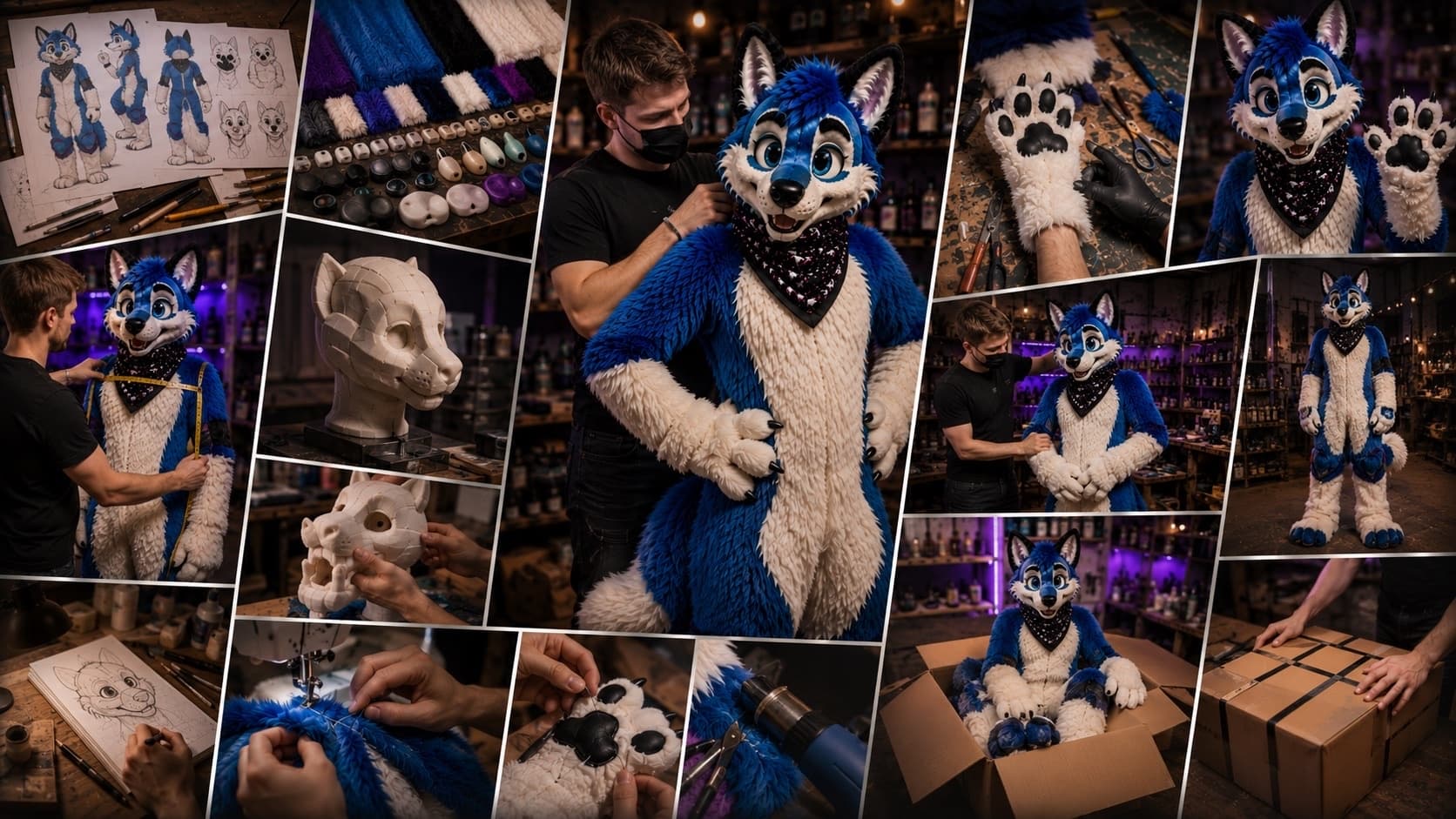
A custom fursuit is a costume crafted by an artisan for a specific character and a specific person—based on your reference images, your measurements, and your choice of features. While you can buy a ready-made fursuit more quickly, finding one that matches both your size and your desired design is largely a matter of luck. Ordering a custom suit takes longer, but the result is a costume you only need to replace if you decide to change characters.
Below is a step-by-step guide to ensure a smooth ordering process—from the initial idea to the moment you put on the finished suit.
Step 1. Decide on the format and budget.
First, decide exactly what you want to order. The price and turnaround time depend on this choice.
- Head — the most expressive part of the costume; this is often where the process begins.
- Mini-partial — head, hand paws, and tail.
- Partial — the above, plus foot paws and, typically, arm sleeves or body padding.
- Fullsuit — a complete costume covering the entire body.
You can find more details about these formats in the article «Types of Fursuits». If you are on a limited budget, it makes sense to order the costume in stages: start with the head and paws, and add the rest later. The key is to coordinate with the maker in advance so that the materials and shades of the different parts match.
Information on cost estimates and how the price is calculated can be found in the article «How Much Does a Fursuit Cost» and in the «Pricing» section.
Step 2: Prepare a reference
A reference sheet serves as the "technical specifications" for the maker. The more comprehensive it is, the less room there is for misunderstanding. A good reference sheet includes:
- front, side, and back views — to show the shape of the muzzle, ears, and tail;
- colors — ideally specific shades rather than vague terms like "light gray"; a color palette or fur samples work well;
- patterns and markings — the placement of stripes, spots, and gradients;
- distinctive features — horns, wings, spikes, fangs, or unusual eyes;
- proportions — muzzle style (cartoon, realistic, or kemono) and head size;
- elements that cannot be simplified versus those that can be sacrificed if the design proves too complex for the costume.
If you don't have a reference sheet, don't worry: many makers can help adapt your artwork or create a sketch. However, this is a separate task that should be discussed upfront. We will cover how to prepare a reference sheet in a separate post; for now, just remember that a flat drawing and a three-dimensional costume are different things, and some details will inevitably need to be simplified.
Step 3. Select a specialist.
Choose based on the work itself, not the price. Here’s what to look for:
- Portfolio. Photos should feature actual costumes, not just 3D renders or other people's work. Pay attention to the seams, the way the fur is fitted, and the symmetry of the face. You can see examples of our work in our portfolio.
- Style. Every maker has a unique style. If you want a realistic fursuit but the maker's portfolio consists of cartoonish heads, you should look for someone else.
- Availability. Many makers work using slots and a waiting list; find out when your order would actually go into production.
- Communication. Do they respond quickly? Do they explain things clearly? Do they promise "everything at once"? These are good indicators of how the order process will go.
- Reviews and recommendations within the community—especially from people who have already received a costume.
Makers in Russia and neighboring countries operate in different ways: some have websites with pricing, while others use only social media. This isn't a bad thing in itself, but it makes getting everything in writing especially important.
Step 4. Discuss the details, cost estimate, and timeline.
Before work begins, the following must be agreed upon:
- the final list of components — what is included in the order versus what is paid for separately (e.g., additional accessories, a moving jaw, ventilation);
- cost and payment terms — every maker has their own policies regarding deposits and payment stages; it is important to have these documented;
- deadlines — and what happens if the date changes (e.g., due to material availability or the maker's health);
- what happens if you change your mind or the result differs from the agreement — the process for revisions and refunds;
- how you will receive updates — such as progress photos or videos.
The more specific the agreements, the easier it is for both parties. If you order from us, all details are discussed after the initial request, and the terms are finalized before work begins.
Step 5. Production: what happens to your order
In general terms, the work proceeds as follows (see the “Process” section for more details):
- Material selection — fur of the required color and length, the head base, eyes, and stuffing materials.
- Head base and shaping — the base is cut, molded, or 3D-printed, then covered with fur.
- Cutting and sewing — preparing the fur for the head, body, paws, and tail.
- Details — eyes, teeth, tongue, nose, and ears; fur coloring and trimming.
- Assembly and final finishing touches.
A good maker will show you the intermediate stages. It is perfectly normal to ask questions and request adjustments during the early stages: changing the muzzle shape is easy while working on the base, but nearly impossible once the head is already covered in fur.
Step 6. Measurements and fitting
Creating a fullsuit or partial suit requires measurements to ensure a good fit that doesn't restrict movement. Many makers use a "duct tape dummy"—a cast of the body made from duct tape over plastic wrap, used to create the pattern pieces; for remote orders, the client creates this at home following the maker's instructions. Typically, measurements include head circumference, chest, waist, and hip measurements, as well as arm and leg lengths. It is best to take measurements while wearing lightweight, form-fitting clothing, and to follow the maker's specific instructions for the head. If you are in a different city, the maker will explain how to take the measurements yourself and what photos to provide.
If possible, schedule a fitting before final assembly: minor fit adjustments are easier to make before everything is permanently secured.
Step 7. Receipt, inspection, and initial outings
When the order is ready:
- inspect the costume immediately: check the seams, the attachment of parts, the symmetry, and the movement of the eyes and jaw (if applicable);
- try it on and ensure you have good visibility, can breathe easily, and the headpiece isn't too heavy;
- ask about care instructions: how to clean, dry, and store the fur, and what products to use on the interior;
- save your correspondence and photos of the finished costume — you may need them for warranty-related matters.
Keep your initial outings short: see how you feel in the costume and plan for breaks.
Common ordering mistakes
- Choosing based solely on price. A "cheap" fursuit rarely ends up being a bargain; alterations or repairs will cost more in the long run.
- Incomplete reference sheet. This can lead to unexpected extra charges or discrepancies between the result and your expectations once work is underway.
- Changing the design mid-process. Every revision made after work has started costs time and money.
- Failing to document agreements in writing.
- Ignoring comfort. Visibility, ventilation, and the weight of the headpiece matter more than you might think; in hot weather, the suit can quickly become an ordeal.
- Not allowing a time buffer. Aiming for a "by the convention" deadline without a safety margin is a common source of stress.
Questions and Answers
Can I order a fursuit without a finished reference sheet? Yes, but that entails additional work—specifically, sketching and design approval. Be sure to clarify beforehand whether this is included in the price.
How do I know if a maker is trustworthy? Look at their actual work and reviews, and pay attention to how they communicate: do they give substantive answers, are they willing to show work-in-progress stages, and do they document agreements?
Can I order a suit from another city? Yes, most makers work remotely: you take your measurements following their instructions, and the finished suit is shipped via mail or courier.
What is better for a first order: just the head or a full suit? Many newcomers start with the head or a "mini-partial" (head, paws, and tail); this is more affordable, and the experience of wearing the suit will be useful when you order the rest. The choice depends on your budget and goals.
Submit a request
If you’d like to order a fursuit from us, please submit a request: tell us about your character and include a reference image and your budget. We will evaluate the project and get back to you with a timeline and cost estimate. In the meantime, feel free to view our portfolio and check out our pricing.
Want a custom fursuit?
Tell us about your character — we will assess the project and name the timeline and price.