
3D-printed fursuit base: models, materials, and post-printing finishing
How to make a fursuit head base on a 3D printer: where to find the model, what materials to use (PLA, PETG, TPU), and how to assemble the parts, sand them down, and fit the base to your head.
- #materials
- #3D
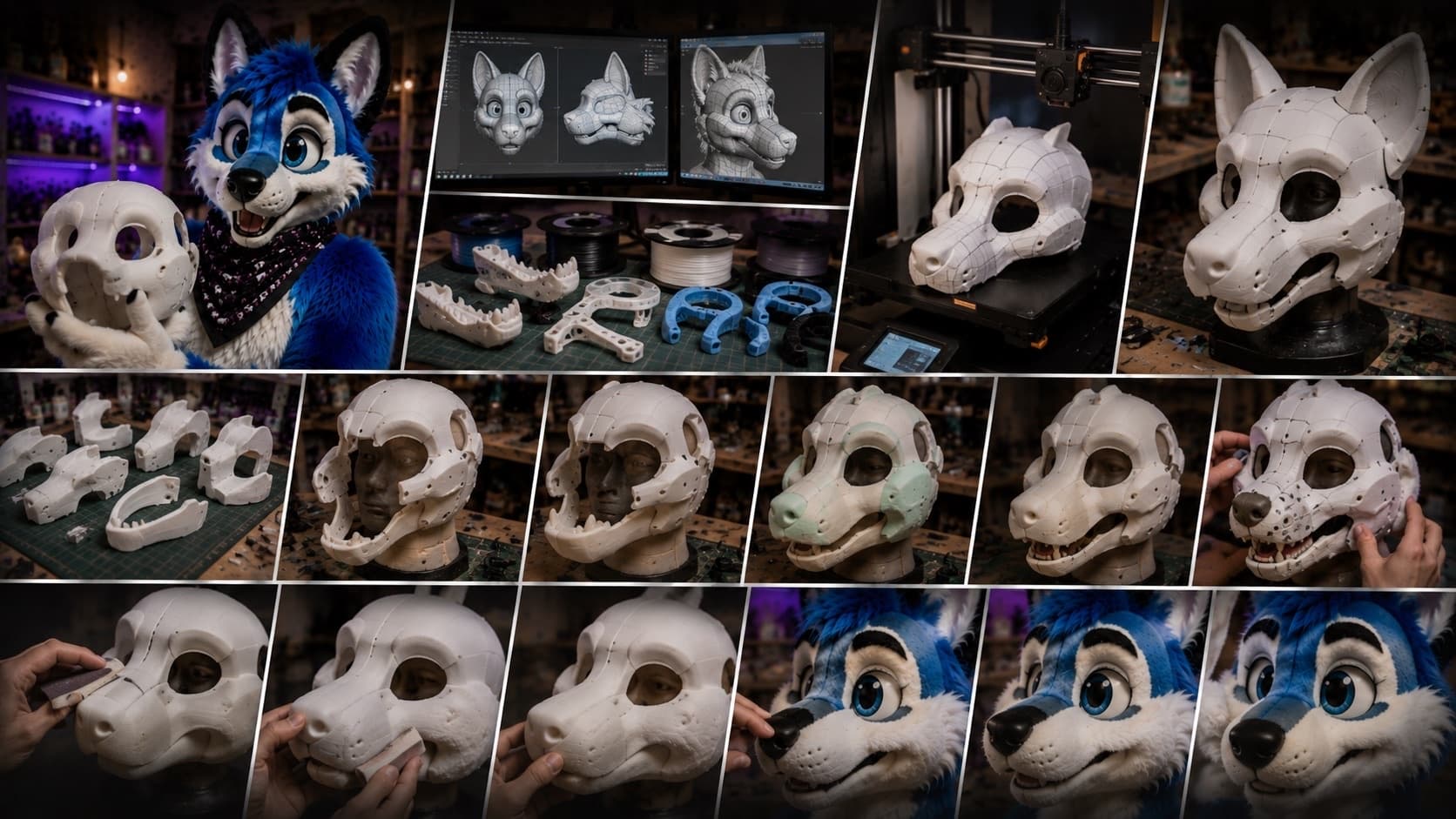
Why print the base?
3D-печать даёт то, что сложно получить из пены: точную, симметричную форму и возможность заранее заложить отверстия под глаза, вентиляцию, крепление челюсти и электронику. Поэтому печатные основы популярны для реалистичных костюмов и протогенов. Общее сравнение материалов основ — в статье «Основа для фурсьюта»; здесь разбираем именно печать.
Where to get the model
Ready-made models are available on 3D file platforms and in maker marketplaces; options exist for dogs, cats, snow leopards, Sergals, Protogens, and other species. Some are sold as kits of pre-printed parts for self-assembly.
Before use, check the following:
- license: whether the model can be used for commercial orders;
- size: many files require scaling—for example, to approximately 105% for an average adult;
- clearance: ensure there is adequate space for the face, neck, and eyes, as well as proper ventilation.
You can also commission a custom model tailored to your head measurements.
What to print with
| Material | Characteristics |
|---|---|
| PLA | Lightweight and non-toxic; captures fine details well. Rigid and brittle: prone to cracking upon impact |
| PETG | Commonly used for structural frames; suitable for sanding, priming, and painting |
| TPU | Flexible and elastic: softer and more impact-resistant than PLA, PETG, or resin, but less rigid than foam |
| Photopolymer resin | High level of detail, but brittle |
In one example, a head printed from PLA weighed approximately 283 grams. The actual weight depends on wall thickness and size; some designs feature walls around 10 mm thick, while thickness is sometimes adjusted when printing with TPU. Ask the maker or seller for the weight of the finished base.
Printing in sections and assembly
The head is usually larger than the printer's build area, so it is printed in sections and then glued together. The files are designed so that the parts are printed at the same scale. Assembly and fitting are done manually: checking the fit, sanding the edges, gluing, and reinforcing the seams.
What to do after printing
The printed base cannot be covered with fur immediately. To achieve a smooth surface, it must be processed:
- Sanding — removes the print layers.
- Priming — evens out the surface.
- Resanding — ensures a smooth finish.
- Painting — especially if the base will be visible (mouth, eyes, visor).
Black PETG is suitable for sanding, priming, and painting; colored PLA looks neat without painting.
Work in a well-ventilated area and wear a mask while sanding: plastic dust is harmful.
Fit and comfort
- Check the fit. Try on the base before applying the fur: check visibility, eye alignment, and jaw mobility.
- Add an inner lining. Foam strips on the forehead and cheeks center the head and absorb sweat.
- Plan for ventilation. An enclosed head overheats quickly; incorporate air vents and a mounting spot for a fan.
- Consider the weight. 3D prints are heavier than foam if the walls are thick; the head shouldn't be front-heavy.
- Protect fragile areas. Rigid prints can crack if dropped; store and transport the head in a hard case.
Pros and cons
Pros:
- accuracy and repeatability;
- high level of detail;
- ability to incorporate mechanical and electronic components;
- rapid modification of the digital model.
Cons:
- brittleness of rigid plastics;
- weight associated with thick walls;
- labor-intensive post-processing;
- requires a printer, materials, and expertise.
Printing it yourself, buying it, or ordering it
- Printing it yourself is a good option if you have a printer with a large enough build volume and are prepared to handle the sanding and fitting.
- Buying a pre-printed base is easier, but be sure to check the surface quality and ensure it fits your head size.
- Ordering a head from a professional maker is the best choice if you want a finished result without the need for experimentation. You can find details in the ordering guide and pricing in the “Pricing” section.
To learn what to do next with the base, check out the “How to Make a Head” guide and the articles on patterns and fur.
Questions and Answers
Which plastic is best for the base? For a rigid, neat base—PETG or PLA; for impact resistance—TPU. The choice depends on your specific needs and printer.
How much does the printed head weigh? It ranges from approximately 300 grams for lightweight versions to significantly more if the walls are thick; the exact weight depends on the model and wall thickness.
Does the printed base need sanding? Yes, if the surface will be visible or if a smooth base is required for attaching fur; sanding and priming eliminate visible layer lines.
Can I get it printed without having a printer at home? Yes: you can order prints from studios or makers, though you will still need to handle the fitting and post-processing yourself.
Want a custom fursuit?
Tell us about your character — we will assess the project and name the timeline and price.