
Paper and cardboard fursuit: how to make a head out of paper, cardboard and papier-mâché
How to make a fursuit head base out of paper, cardboard, or papier-mâché: templates, reinforcement, lining, and what holds up to wear versus what doesn't. Suitable for beginners and for testing out an idea.
- #DIY
- #materials
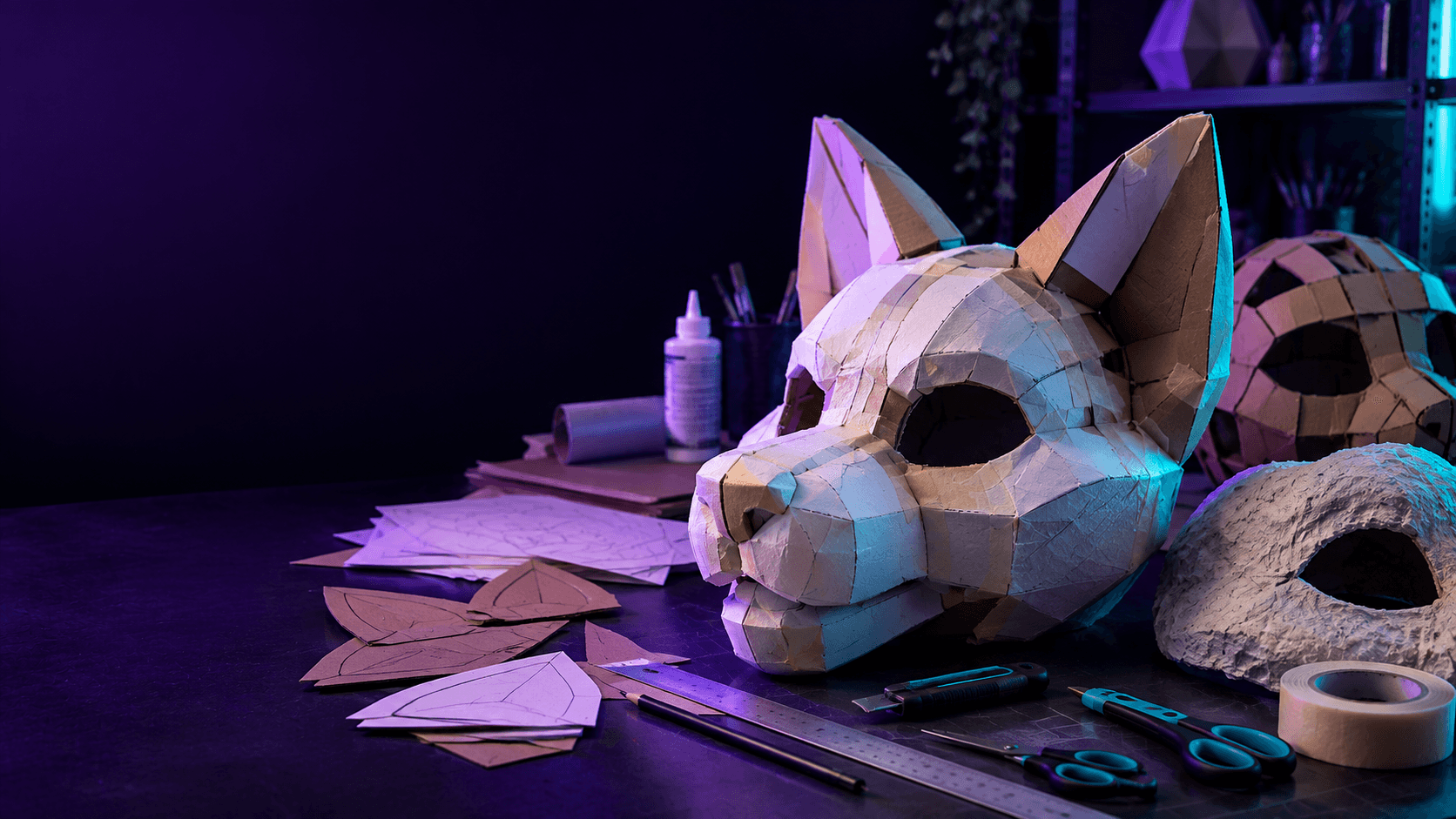
Why make it out of paper?
Paper and cardboard are the cheapest and most accessible materials. They do not require special tools, and the shape can be changed almost immediately. This is a good way to practice: get a feel for the shape of the muzzle, work out the proportions, and test out an idea before investing in foam and fur.
But it is important to understand the limitations: the paper base is not durable. Comparison with other materials is in the article “Basis for fursuit”.
Three approaches
1. Paper "faceted" mask
The simplest option: draw your character from the front and side, break the skull down into flat planes, and cut them out. This creates a "faceted" mask assembled from paper or thin cardstock.
Pros: minimal materials, quick, convenient for testing an idea.
Cons: facets are visible, the shape is rough; requires further work to smooth it out.
2. Cardboard framework (helmet)
Create a base out of thick cardboard: a headband strip around the head with intersecting straps on top, secured with tape or glue so the structure holds its shape. Build the muzzle shape over this framework.
Pros: sturdier than plain paper, shape can be quickly altered.
Cons: cardboard creases easily and "remembers" the folds.
3. Papier-mâché
Cover paper or cardboard forms with layers of paper and glue. This smooths out the planes and reinforces the framework. You can use masking tape instead of heavy-duty tape, apply a thin layer of papier-mâché over it, and then paint.
Pros: smooth surface, easy to paint.
Cons: long drying time, sensitive to moisture, becomes heavy if the layer is thick.
There is also the template-based method (Pepakura): parts are printed on heavy paper (around 200 g/m²; standard 80 g/m² paper is too flimsy) and assembled. For added strength, Pepakura models are coated with resin or fiberglass, though that represents a more advanced level of craftsmanship.
General workflow
- Draw a reference: include front and side views, and the proportions of the muzzle and ears.
- Create a pattern or a cardboard framework.
- Glue it together and test the fit: check your visibility, ensure it doesn't press against your face, and make sure it slips on easily.
- Refine the shape: add volume and smooth out the edges using papier-mâché.
- Reinforce weak points: the jaw, ear attachments, and entry points.
- Add padding: foam strips on the forehead and cheeks help center the head and absorb sweat.
- Cover with fur or paint — following the guides "How to Make a Head" and "Fursuit Patterns".
Strength and weight
- Durability is the main trade-off. Weak spots appear after a few wears—specifically where the jaw hinges and where the head is put on. Paper "remembers" creases, so reinforce these areas with extra layers right from the start.
- Weight. A paper head is usually lighter than a foam-and-fur one.
- Moisture. Sweat and rain damage the paper and glue. It is best to avoid wearing this type of head for long periods in hot weather.
An inner lining is essential: bare cardboard against the face is uncomfortable and unstable.
What it is suitable for—and what it isn't
Suitable:
- for the first experiment and training;
- for prototyping and testing ideas;
- for photos and temporary displays.
Not suitable:
- for regular wear;
- for hot weather and active events;
- for a head with a movable jaw and electronics.
If you want a suit to last, it is better to switch to foam or other bases.
How to advance to the next level
Once the shape is perfected, many transfer it to foam, using the paper model as a template. This way, you get a proven shape without unnecessary expense. The general process is described in the guide "How to Make a Fursuit", while the article "DIY Fursuit" covers where to start.
Questions and Answers
Can a tail be made out of paper? It’s possible for a one-off costume, but it won’t last long; see the article “Fursuit Tail” for details.
Which material is best: paper, cardboard, or papier-mâché? Paper or cardboard for the prototype; papier-mâché for smoothing the shape. For regular wear, all three are less durable than foam.
Will a head like this withstand the rain? No: moisture damages the paper and glue.
Can such a base be covered with fur? Yes, provided it is sturdy enough and doesn't press against the wearer; however, for reliable, long-term use, it is better to transfer the shape to foam.
Want a custom fursuit?
Tell us about your character — we will assess the project and name the timeline and price.