
Moving Fursuit Jaw: How It Works, Pros and Cons
How a fursuit's moving jaw works: spring or elastic mounting, the bypass method, and fur placement. What can go wrong, and is it worth paying for this kind of mechanism?
- #mechanics
- #head
What is a movable jaw?
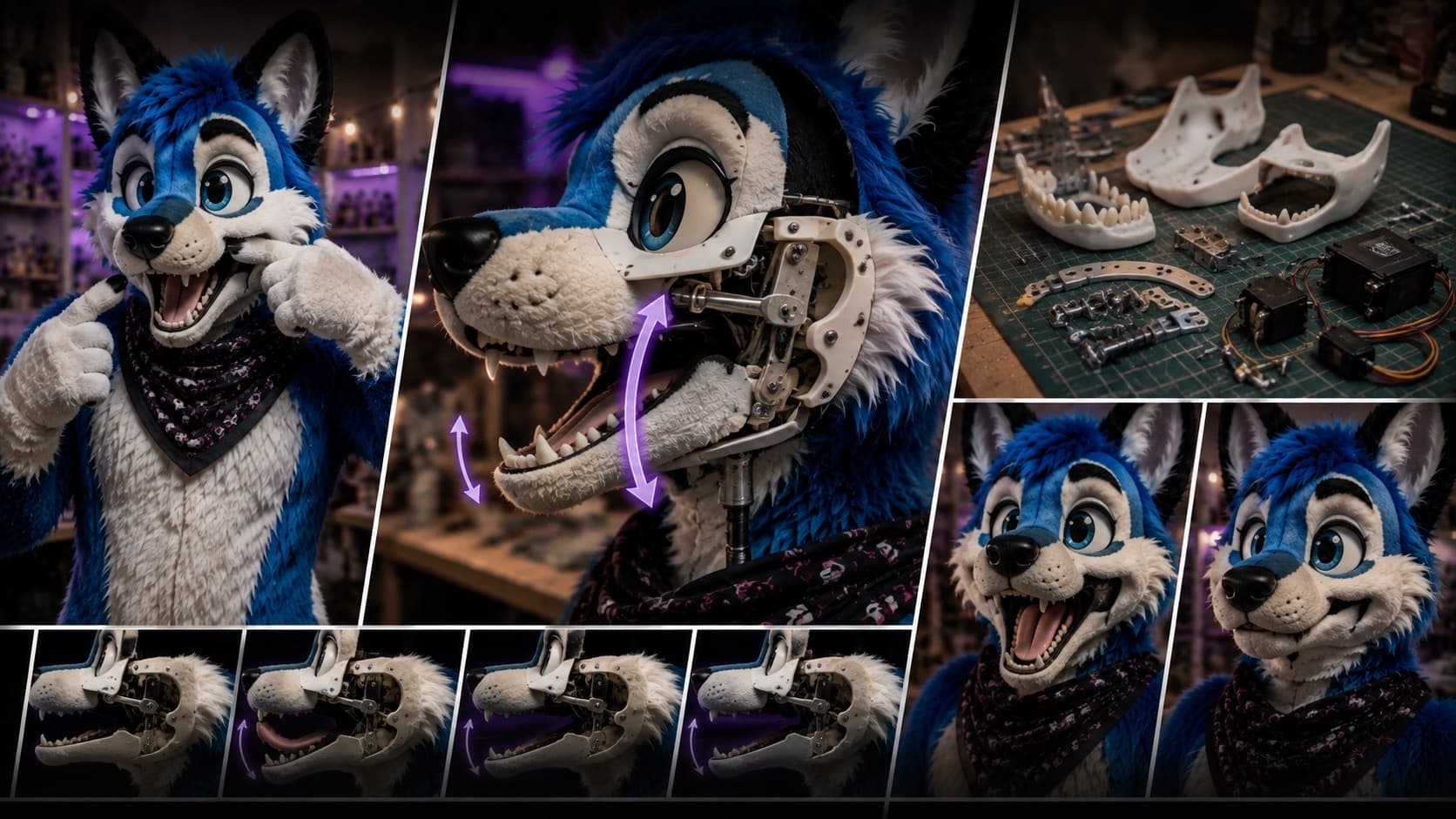
A movable (hinged) jaw is the lower part of the muzzle that opens and closes when you move your chin. It brings the expression to life, helps with "speaking," and adds character to the costume. However, this is a mechanical feature that requires careful planning and high-quality execution.
How it is structured
Designs vary among makers, but two main approaches are common:
- With a spring or elastic band. An elastic band or spring keeps the jaw closed when the mouth is not moving, ensuring the muzzle looks neat while at rest.
- Springless. The jaw is held in place by the structure and shape itself. This method works well with various base types and allows for size adjustments.
Makers often use a sturdy elastic band—glued over the foam and stitched at the top—and construct the mounts from plastic or thermoplastic; the hinge mechanism can be concealed by overlapping the components (the "overlap" method).
Pros
- Expressive facial movements: the muzzle "talks" when the chin moves.
- Makes photos and videos look more lifelike.
- Looks especially impressive on animals with large mouths: wolves, dogs, and raptors (raptor fursuit).
Drawbacks and risks
If the mechanism is installed improperly, several issues may arise:
- excessive jaw stiffness — operating it requires effort, making the head tiring to wear;
- insufficient opening or a complete lack of movement;
- head slippage — the jaw slides off the wearer's chin or shifts the entire mask up onto the forehead;
- fur bunching — excess fur around the mouth may be visible and wrinkle.
To minimize these risks, the fur around the mouth is cut with extra allowance, and the base is patterned with the jaw in the open position; this ensures the fur does not stretch tight during movement. This extra allowance is especially important if the fur is non-stretchy. For more details on patterning, see the article “Fursuit Patterns”.
Impact on price and timeframe
The movable jaw is an additional design: you need to design, manufacture and fit it. This increases labor intensity and cost; For more details about the price components, see the article “How much does a fursuit cost”. Lay it down at the foundation stage: modifying a finished head is more difficult than doing it right away.
Tongue, gums, and teeth
The inside of the mouth—the tongue, gums, and teeth—also shapes the overall impression. These elements are crafted from plastic, silicone, or felt; silicone molds are sometimes used for the teeth and gums when consistency is required. The specific details depend on the style of the muzzle: they are simpler on cartoon-style suits and more detailed on realistic ones.
How to choose: with or without a jaw
With a movable jaw, if:
- facial expressions and “talkativeness” are important to you;
- are you ready for a higher price and careful care;
- the base and fur allow you to do this.
Without it, if:
- you choose a budget option or your first suit;
- lightness and reliability are more important;
- a character with a style where the mouth is closed (for example, kemono).
Order details are in instructions, and for independent work - in head guide.
Questions and Answers
Does a beginner need a movable jaw? Not necessarily; it complicates the work and adds to the cost. Many people start with a fixed jaw.
Is it worth paying extra for a movable jaw? If facial expression is important to you—yes. However, make sure the maker has experience creating such mechanisms.
Which should you choose: a spring or no spring? It depends on the base and the design; ask the maker which option they use and why.
If you want to find out if a movable jaw is an option for your character, submit a request.
Want a custom fursuit?
Tell us about your character — we will assess the project and name the timeline and price.