
Fursuit Tail: How to Make and Attach It
How to make a tail for a fursuit: pattern, frame, filler and attachment to the belt. Which option is suitable for a beginner and how to make the tail movable.
- #DIY
- #accessories
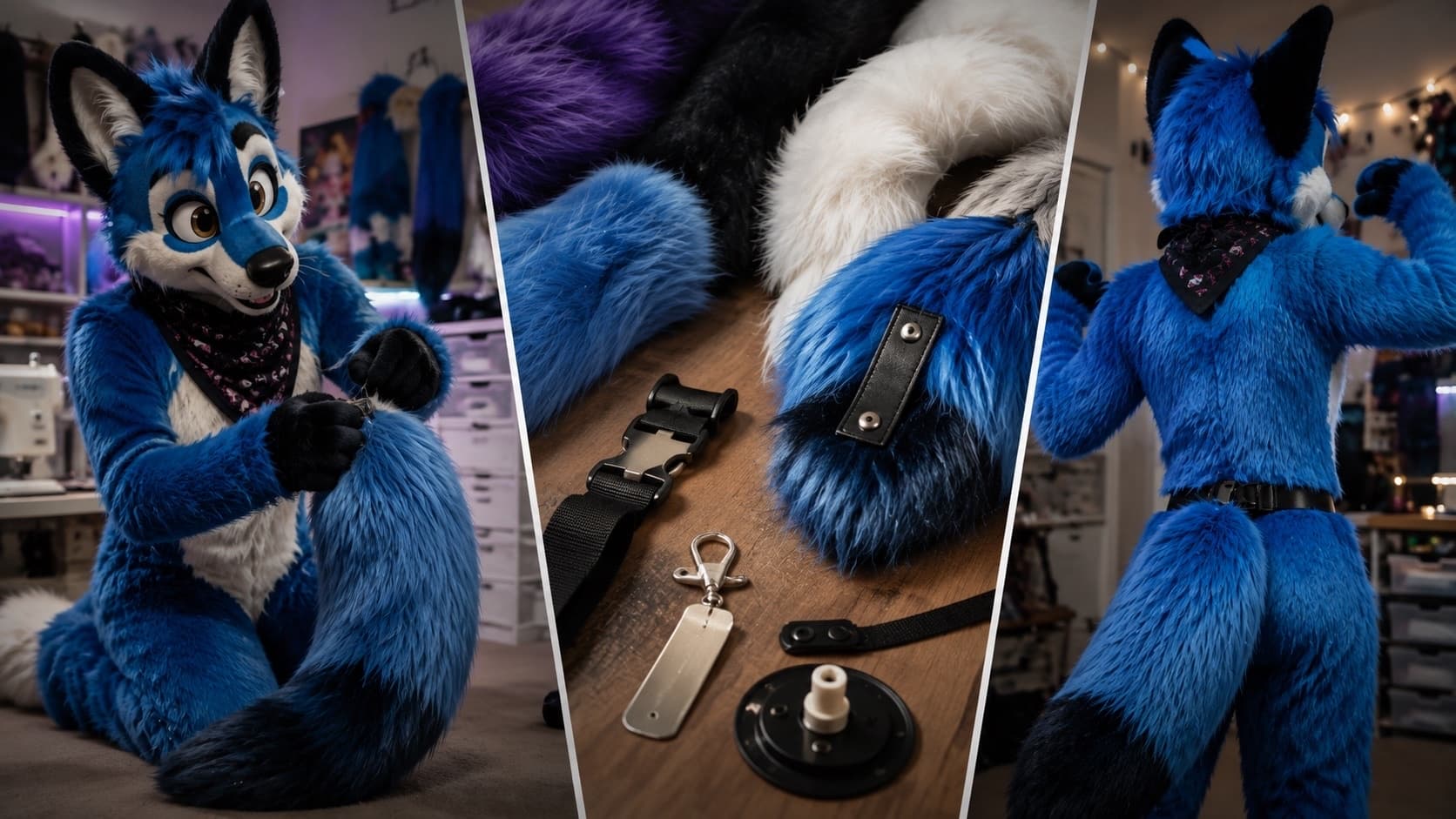
Why it’s worth starting with the tail
A tail is one of the simplest projects in the fursuit-making hobby. It requires very little material, is forgiving of mistakes, and teaches the basics: how to cut and sew fur according to the direction of the pile, how to stuff the piece, and how to attach it to the costume. That is why beginners are often advised to start with a tail before moving on to paws and the head (read more about where to start).
What the tail is made of
- Outer layer — faux fur in the desired color (how to choose).
- Filling — synthetic down (poly-fill), foam strips, or batting.
- Structure (optional) — wire, tubing, or a foam core.
- Attachment and lining — belt, Velcro, buckle, or pocket.
The filling determines the look and weight: synthetic down creates a soft, "plush" tail, while foam holds its shape and is suitable for long, fluffy designs.
Types of tails
- Soft, frameless tail. The simplest type: fur stuffed with synthetic fiberfill. Well-suited for short tails.
- Wire-frame tail. A wire runs through the interior, allowing the tail to be bent and posed. For long tails, multiple support wires are often used.
- Central-core tail. Features an internal foam core—tapered into a cone shape and wrapped in a thin layer of batting—resulting in a tail that is voluminous yet lightweight.
- Articulated tail. Constructed using a mechanical system or joints; requires a more complex design.
How to make a ponytail (general outline)
- Determine the shape and size. Draw the tail on paper, noting the length and the thickness at both the base and the tip. For complex shapes, create a pattern using tape over a temporary form.
- Cut the fur. Cut two mirror-image pieces, including a seam allowance; ensure the fur pile runs from the base toward the tip. For details on cutting fur correctly, see the articles "Fur" and "Patterns".
- Sew the pieces together with the right sides facing inward, leaving an opening at the base.
- Turn the tail right-side out and check the seam. Use a needle to pull out any trapped fur fibers.
- Prepare the armature and stuffing. Secure the wire inside, then stuff the tail evenly.
- Close the base and sew on the attachment mechanism.
- Trim and brush the fur to make the tail look fluffy and ensure the seams are hidden.
For an overview of the costume-making process, see the guide "How to Make a Fursuit".
How to attach the ponytail
It is better to transfer the weight of the tail to your hips rather than letting it pull on your clothing. Common solutions include:
- Internal belt. A thin nylon strap worn under your clothes; the tail attaches to it via a loop or carabiner, shifting the weight to your hips.
- Belt with Velcro or a buckle — a simple option for lightweight tails.
- Frame attachment. The wire or rod extends beyond the tail itself and tucks behind your belt.
Choose your attachment method based on whether you will be sitting or walking; a long, heavy tail can be cumbersome on public transport or in indoor spaces.
How to make a tail movable
Mobility is achieved in various ways:
- a flexible wire frame that sways while walking;
- multiple hinged segments;
- mechanics or electronics — for advanced projects.
For a beginner, it is more sensible to start with a flexible frame and then increase the complexity.
Weight and comfort
- Check the weight beforehand. A long-furred tail stuffed with foam can become too heavy.
- Round off the base so it doesn't dig into you when you sit down.
- Make it detachable: the tail should be easy to remove if you need to sit, squeeze through a narrow space, or take a break.
Common mistakes
- Fur against the grain — the tail looks "ruffled."
- Too much stuffing — the tail becomes heavy and sausage-like.
- No internal support in a long tail — it sags and creases.
- Weak attachment — the tail slips down or falls off.
- No seam allowance.
Order it or make it yourself
You can easily make a simple tail yourself. However, if you need a complex design or an articulated tail, it is easier to order it along with the rest of the costume. You can find prices and options in the Pricing section, and view examples in the portfolio. We have outlined the ordering process in our guide.
Questions and Answers
What is the easiest type of tail to make? A soft, un-armatured tail made of faux fur and synthetic fiberfill. This is a good choice for beginners.
What should I use to stuff the tail? Synthetic fiberfill for a soft look, or foam for structure. For long tails, an internal frame (armature) is added.
How do I make a tail out of paper? For a one-time costume, you can construct a shape out of cardboard and cover it with paper, but this type of construction isn't durable and is easily damaged by moisture. For regular wear, use fabric and faux fur instead.
Where should the tail be attached? To a belt—or better yet, to an inner belt worn under your clothing—so the weight is distributed across your hips.
Want a custom fursuit?
Tell us about your character — we will assess the project and name the timeline and price.